
Buyers study the purchase price for months and then discover that the thrill ride operating cost decides whether the ride is a good investment. Running cost is simpler than it looks, and it has only four parts.
Here is how to budget a thrill ride before you buy it, using the DINIS models as the example.

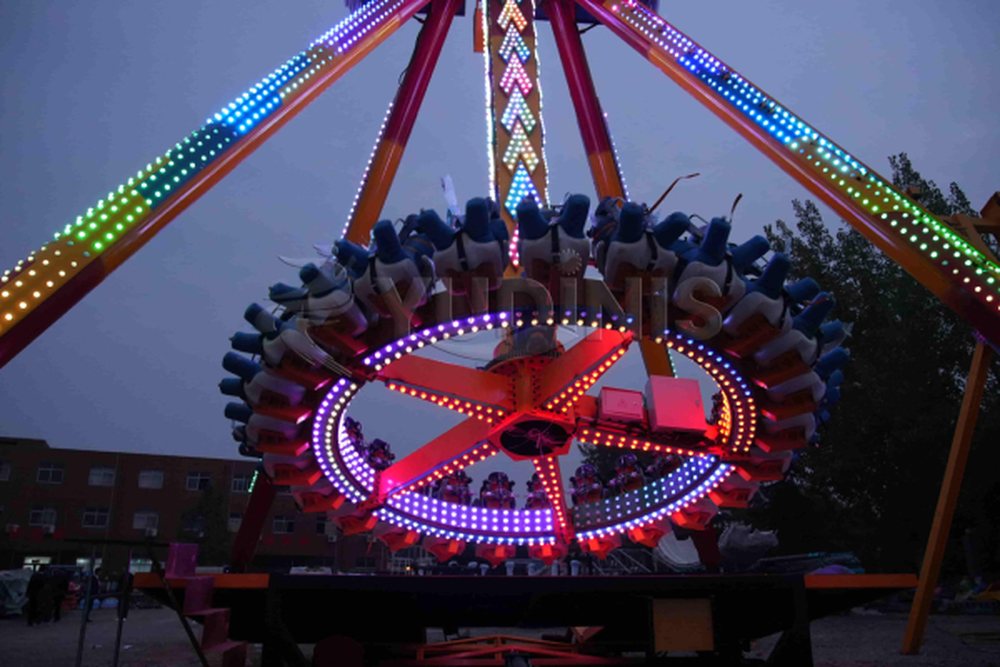
Thrill ride operating cost: the four parts
| Cost line | Giant pendulum | Flying sky | Flying turntable |
|---|---|---|---|
| Installed power | 80 kW | 45 kW lift + 30 kW rotation | 85 kW |
| Staff per shift | 2 to 3 | 2 to 3 | 2 |
| Riders per cycle | 25 | 32 | 24 |
| Design life | 12 years | 15 years on the tower | 15 years |
Fatigue, dust and daily wear do not appear in that table, but they are the reason maintenance budget matters as much as the power bill.
Power: the number everyone asks about first
Installed power is the peak figure. A pendulum does not draw 80 kW all day: the swing motors work hard in short bursts, and the rest of the cycle is quiet.
What you pay in electricity depends on how many cycles you sell. A ride that turns 200 cycles a day costs more to run than the same ride turning 60, and it also earns more. Watch the queue, not the meter.
Staff: the cost that never switches off
Every ride needs an operator and a gate attendant for every hour it opens. Two people per shift on a 12-hour day is 24 paid hours before you sell a ticket.
That is why planning the operating hours of a new thrill ride matters: an extra hour that sells 20 rides is usually worth it, an hour that sells four is not.
Maintenance: budget it from day one
Maintenance on these rides is mostly routine: bolts, bolts again after commissioning, hydraulic levels, brake checks, lighting and seat restraints. Wear parts are standard components rather than one-off customs, which keeps reorders simple.
The designed service life is 12 to 15 years, and the rides that reach the far end of it are the ones with records from the start. Keep the manual, log the checks, and your inspector and your mechanic both work faster.
How to turn that into a daily budget
Write down four figures: the power you expect to use, the staff hours you plan, the maintenance budget per month, and the number of rides you expect to sell on an average day.
Divide the first three by the last one and you have your cost per ride. Compare it with your ticket price. If the gap is comfortable, the ride works; if it is thin, change the opening hours before you change the ride.
Questions buyers ask about running costs
Do thrill rides need a dedicated technician?
No, but they need a trained operator and a maintenance routine. Most parks train existing staff.
Is a bigger ride always more expensive to run?
Usually, because power and inspection time both grow. The flying turntable is the cheapest of the three to operate.
Does the design life mean the ride is finished after 12 years?
No. It is the period the design assumes with proper maintenance. Rides with records usually run well beyond it.
Related: flying sky · flying turntable · thrill rides