Buying notes for the 42m Ferris Wheel
A 42m ferris wheel is usually the first big ride a new park buys. It is tall enough to be seen from the road, simple enough to run with two people, and it fits a 20 x 20 m plot.
Twenty-four pods carry 96 passengers, and one turn takes 7.9 minutes. Those numbers are the whole business case, so it is worth understanding what they produce in a day.
What 96 riders per turn means for ticket income
A 7.9 minute lap is roughly 7.5 turns an hour. At 96 seats that is a theoretical 720 riders an hour, and no park reaches the theoretical figure because boarding takes time.
Use a conservative half: 350 to 400 riders an hour is realistic once the wheel is stopping for groups. As an illustration only, 400 riders a day at a US$3 ticket is US$1,200 of gate income; at US$5 it is US$2,000. Put your own ticket price in and the payback arithmetic becomes clear before you order.
Do this before you sign: Write the ticket price, the expected riders per day and the opening days per month on one page. If the ride does not clear its operating cost at half the traffic you hope for, the site is not ready for a wheel this size.
The land question: 20 x 20 m
The plot is 20 x 20 m and the slewing diameter is 37.5 m, so the wheel is wider than its base. Plan the fence and the queue outside that circle, and keep the service access to the drive room clear.
A city square, a commercial district or a waterfront promenade usually has the plot. What those sites often lack is a clear view: put the wheel where the top of the turn looks at something worth photographing.
Running cost: 12 kW and two staff
Drive power is 12 kW, made up of 1.5 kW per pod group across eight groups. Compared with a thrill ride, the wheel is cheap to run: it turns slowly, it carries a lot of people and it does not need a large crew. If the plot is still being chosen, how much land a ferris wheel needs sets out the clear circle and the access you have to keep free. A resort park in Iraq combined the wheel with other rides; the project notes cover the mix.
Two staff handle loading and the control panel in normal operation. Add one more on peak days for the queue.
A wheel as a landmark
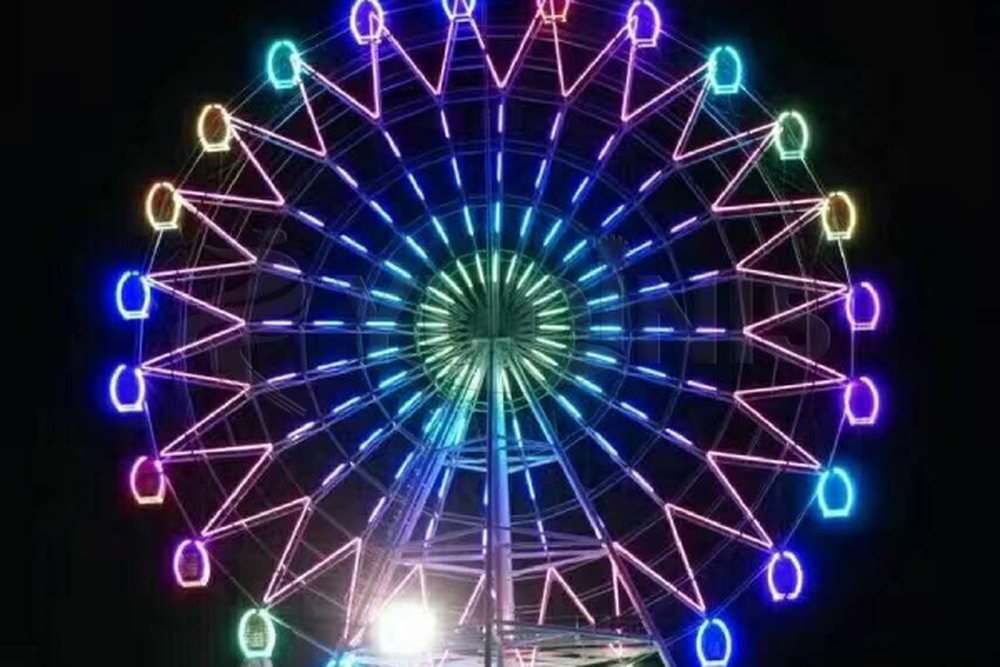
On a plaza or a promenade the wheel is the thing people photograph. Lighting matters more than theming here, because most of the ticket income arrives after dark.
A wheel as an anchor
Inside a park the wheel extends the visit and gives families a slow ride between the thrill rides. Position it on the main axis so it is visible from the gate.
Where the 42m wheel sits in the range
It is the entry point to observation wheels. The 50m ferris wheel carries 128 riders in 32 pods and needs a 35 x 32 m plot, so the step up is as much about land as about height.
If you are comparing a wheel with a tower, the tower range delivers more thrill on a tighter base, while the wheel delivers capacity and a longer, calmer ride.
Questions buyers ask about the 42m ferris wheel
Technical reference: height 42 m / slewing diameter 37.5 m / 24 pods x 4 seats = 96 riders / loop time 7.9 minutes / drive power 1.5 kW x 8 = 12 kW / footprint 20 x 20 m.
Part of the ferris wheels range built by DINIS.
- Country
- Site size or plan
- Indoor or outdoor
- Rides you have in mind
- Opening date
Prefer to talk? WhatsApp us, or email [email protected]