Buying notes for the Carnival Train for Sale
A carnival train for sale should be planned around the way the event moves, queues and trades. A travelling fair needs a route that can be assembled and moved; a fixed fairground needs a landmark; a festival or shopping event needs high passenger turnover over a short trading period. DINIS builds quoted configurations from 16 Zu 72 Passagiere, with one cab pulling one or two passenger carriages.
The strongest carnival train project connects the event format to a practical operating plan. A travelling fair needs a route that can be assembled, operated and moved; a fixed fairground needs a memorable landmark; a festival or shopping event needs high passenger turnover over a short trading period. Passenger flow, route length, Einsteigen, Oberfläche, body style and battery or diesel drive follow from that decision.


Carnival train for sale: the current configuration range
The quoted range starts at 16 passengers and extends through 22, 30, 42, 58 Und 72. Final capacity depends on the number of carriages, seat layout, operator requirements and the approved configuration. Do not assume a capacity, battery and body style that are not written into the quotation.
| Purchase decision | Quoted options | What it changes |
|---|---|---|
| Carnival train capacity | 16, 22, 30, 42, 58 oder 72 Passagiere | Carriage count, route throughput, station length and the vehicle selected for the event or park. |
| Train layout | One cab with one or two passenger carriages | Turning behaviour, boarding capacity and the space needed at stops and the depot. |
| Body style | Open or semi-enclosed; fully enclosed optional | Weather protection, visibility, passenger comfort and the appearance of the train. |
| Air conditioning | Optional, quoted per build | Electrical load, roof or equipment packaging, maintenance plan and passenger comfort. |
| Fahren | Batterie, or Cummins 96 kW diesel | Charging or refuelling infrastructure, route schedule, Lärm, ventilation and operating cost. |
| Battery option | 72 V 400 Ah lithium option | Charge strategy, battery management, replacement planning and the final electrical specification. |
The carnival train price can start at about US$11,000 for the quoted 16-seat compact direction. Larger configurations move toward the current US$50,100 upper reference through passenger capacity, carriage count, Batterie- oder Dieselantrieb, body enclosure, Klimaanlage, Thema, lighting and shipping scope. A 16-seat quotation must still be matched to its cab, carriage count, battery, finish and route equipment. Fracht, Steuer, local registration, site preparation and installation are separate.
Different price ranges for carnival train projects
The original buying question is still useful: which carnival train fits the investment plan? There is no single price for a carnival train because passenger capacity, carriage count, fahren, body, Klimaanlage, theme and delivery scope change together. Compare the project in three configuration levels instead of asking for one generic quotation.
Seats and carriages
Passenger target and carriage count set the base vehicle size and move the train into a different equipment class.
Battery or diesel
Battery capacity, charging plan or the Cummins 96 kW diesel option changes the drivetrain, operating cost and service scope.
Body and air conditioning
Open, semi-enclosed or enclosed carriages, air conditioning and passenger trim move the specification and price upward.
Thema, freight and commissioning
Beleuchtung, sound, paintwork, Verpackung, freight and installation scope must be quoted against the same venue requirements.
Use the capacity tabs below to match the passenger band. A lower headline price may exclude the carriage count, battery capacity, Klimaanlage, themed lighting, sound system, freight or commissioning required at the venue. For a true comparison, ask every supplier to price the same route and daily schedule.
Carnival train for sale: choose the event format first
Travel between events
Prioritize a compact carriage plan, practical turning radius, protected paintwork, fast inspection and a route that can be marked out again at each fairground.
Become the fairground landmark
Use the locomotive, Beleuchtung, sound and themed carriages to create a visible arrival point. The route can connect the ticket gate, photo spots and neighbouring attractions.
Move a festival crowd
Plan for peak-hour queues, short turnaround, safe pedestrian separation and a route that can be installed around temporary stalls or seasonal decorations.
Carnival layout: from ticket point to boarding gate
The train is often the first attraction a visitor sees, so the layout should turn the vehicle itself into wayfinding. Put the ticket or boarding point where the locomotive and carriages are clearly visible, then keep the queue, gate and train route separate from the public walking route.
- Approach and photo point: give visitors a clear view of the locomotive without blocking the queue or boarding gate.
- Ticket and boarding: set the operator, cashier and gate positions so boarding does not become the bottleneck.
- Route crossings: separate the train from pedestrian flows with barriers, markings or staff at every crossing.
- Attraction interface: coordinate the route with stalls, show fronts, lighting towers and emergency exits so the train does not cut through another operator’s frontage.
- Night operation: plan service lighting separately from decorative LED lighting, and keep both accessible for maintenance.
Trackless carnival train: where it wins and where it costs more
A trackless train avoids permanent steel rail, making it easier to move between fairgrounds or reconfigure a seasonal layout. That flexibility has a trade-off: the route surface, corners, crossings, boarding area and charging or refuelling point all become part of the project design.
For travelling operators, the value comes from repeatable route planning and a train configuration that can be inspected quickly at each site. For fixed fairgrounds, the value is lower civil work and the freedom to redirect the route around future attractions. A themed locomotive cannot compensate for a tight corner, weak surface or unsafe passenger crossing.
Choose carnival train capacity from the event peak
Start with the number of passengers you need to move during the busiest hour. Then account for the number of boarding points, the full route time, the time spent at stops, the turnaround and the percentage of seats you expect to fill.
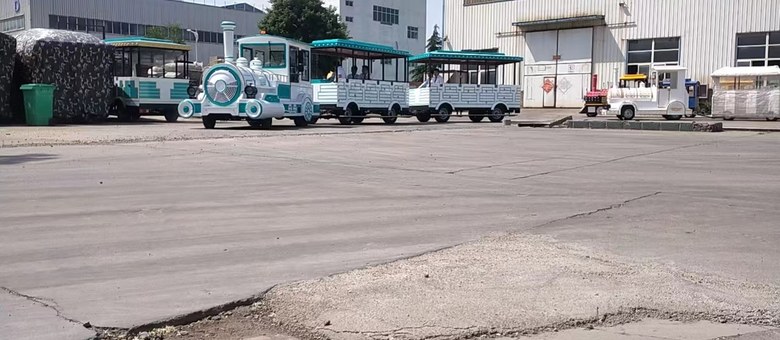
16 Zu 30 Passagiere
Suits shorter routes, travelling events, smaller fairgrounds, plazas and venues where compact transport and fast turnaround matter more than maximum capacity. The quoted 16-seat direction starts around US$11,000; the final figure follows carriage count, battery, body and finish.
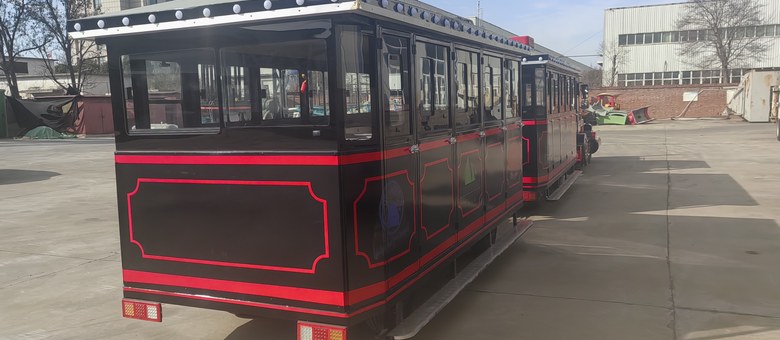
42 Passagiere
Balances passenger flow with a route that still fits inside a resort, family park or large commercial property. It is a practical step for group bookings without moving to the largest train; battery or diesel, body and theme are quoted for the selected route.
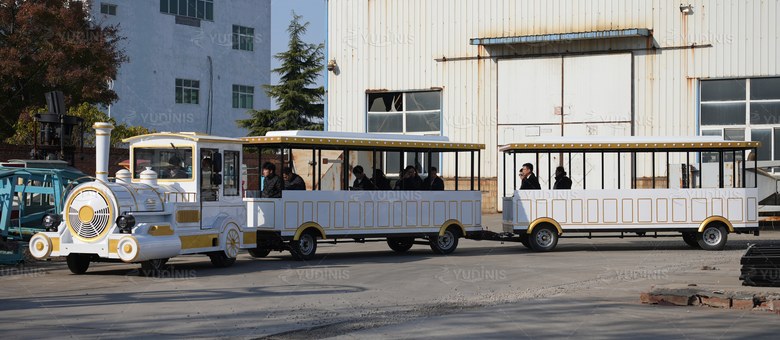
58 Zu 72 Passagiere
Suits high-volume sightseeing loops, larger parks and long routes where fewer departures need to move more passengers. Road width, corner clearance, stop length and depot space become more demanding, with price moving toward the current US$50,100 upper reference.
Use the same calculation for every model: passengers per run × complete runs per hour × realistic occupancy. This gives a planning figure that can be compared with the ticket plan and staffing model.
Battery or diesel drive for a carnival day
Quiet and flexible
Battery drive suits controlled sites where charging time, charging location and battery management can be built into the daily schedule. A 72 V 400 Ah lithium option is available in the quoted range.
Longer operating windows
A Cummins 96 kW diesel option can suit longer routes or schedules where charging windows are difficult. Lärm, ventilation, fuel storage and engine servicing must be planned.
Let the timetable decide
Compare the complete route duration, stoppt, passenger load and daily operating hours. The drive should follow that timetable rather than being selected by appearance alone.
Carnival train carriages: comfort, weather and theme
Open carriages provide the clearest sightseeing experience and fastest boarding in warm, dry conditions. Semi-enclosed carriages add side protection and suit mixed weather. Fully enclosed carriages can support air conditioning and more controlled passenger comfort, but they change the visual character, weight, electrical scope and maintenance plan.
For a carnival or festive route, the body style should also support lighting, signage and theme without trapping water or making daily inspection difficult. Keep the final seat, door, step, handrail and lighting layout in the approval drawing.
Carnival route and fairground planning
Route width, surface and turning
- Route width: check the train plus safe clearance at corners, stoppt, gates and service areas.
- Operating surface: confirm the final train weight and axle loads with a local engineer, and inspect drainage, slopes, joints and weak paving.
- Turning: the quoted trackless models use a minimum turning radius around 7–7.5 m, but the final figure must match the selected wheelbase and carriage configuration.
- Driver visibility: verify mirrors, cameras and blind spots with the selected carriages and route.
Boarding, traffic and daily operations
- Boarding: separate the waiting area from moving traffic, control the gate and provide a safe level-change solution where needed.
- Pedestrian conflict: use barriers, markings, signals or staff at every crossing. Do not mix a passenger route with uncontrolled vehicle traffic.
- Charging or fuel: provide a safe, ventilated location outside passenger circulation and include the equipment in the daily operating procedure.
- Emergency access: keep the route, depot and boarding area reachable for staff and emergency services.
Carnival theme: turning the train into the attraction
The carnival theme is part of the revenue case when the train becomes a visible landmark. Steam-style locomotive forms, bright body colours, LED lighting, music, simulated sound and character details can make the train easy to recognise from a distance.
The theme should be agreed before production because graphics, Lichter, speaker locations, roof details and carriage trim affect the final layout. Keep service access in the design: decorative panels and lighting must still allow inspection and replacement.


Carnival train gallery: locomotive and carriage details
Review the train from the route, body and passenger-space perspective. The mix of locomotive styling, carriage construction and lighting is selected together with the final carnival format.


Trackless carnival train vs rail train
A trackless train avoids the cost and construction time of a steel track and allows the route to change, subject to site approval. A rail train follows a fixed route and can suit a permanent park where the track itself is part of the attraction.
Choose the trackless model when flexibility and a shorter installation are the priority. Compare the rail direction on the amusement park electric train page, large rail sightseeing train page, 36-Personenzug oder 54-Personenzug.

Lieferung, commissioning and operation
- Approve the route
Confirm the station, full route, turning areas, crossing control, charging or fuel point and depot.
- Lock the train configuration
Approve passenger capacity, carriage count, body style, fahren, battery and theme before production.
- Prepare the site
Complete the ground works, Drainage, barriers, markings, power or fuel infrastructure and passenger access.
- Assemble and commission
Check the vehicle against the packing list, complete mechanical and electrical tests and run the route under representative conditions.
- Train the operating team
Hand over driving, Einsteigen, emergency, charging, inspection and record-keeping procedures.
Carnival train questions buyers ask
Which carnival format changes the train specification most?
A travelling carnival has the greatest effect on specification because the route must be recreated, inspected and operated at different sites. Carriage count, Wenderadius, body protection and the charging or fuel plan should be fixed around that requirement.
How many passengers can it carry?
The quoted range starts at 16 passengers and extends through 22, 30, 42, 58 Und 72. Final capacity depends on the selected cab, carriage count, seat layout and approved configuration.
Can a carnival train be trackless?
Ja. Trackless operation is common because the train does not need permanent steel rail. It still needs a planned route, suitable operating surface, controlled crossings and safe turning areas.
Is battery or diesel drive better?
Battery drive suits sites with planned charging windows and controlled operating areas. Diesel can suit longer schedules and sites where charging access is difficult. Decide from the route timetable, infrastructure and operating cost.
How much site preparation does a trackless carnival train need?
The route needs a suitable, well-drained surface capable of carrying the loaded vehicle, with clear corners, stops and crossings. Confirm the final loads and route conditions with the quotation and local engineer.
How much clearance should we add beyond the minimum turning radius?
Quoted trackless models are listed around 7–7.5 m, but that figure is not the complete route width. The site plan should show the swept path for the selected wheelbase and carriages, then add safe clearance for pedestrians, stalls, gates and service access.
Which carriage type suits hot, wet or mixed-weather events?
Open carriages work best in warm, dry conditions. Semi-enclosed bodies add weather protection for mixed seasons. Fully enclosed and air-conditioned carriages improve comfort but increase electrical scope, weight and maintenance requirements.
When does a rail carnival train justify permanent track?
A rail train is strongest at a fixed park where the track becomes part of the attraction and the route does not need to move. For travelling events, a trackless train avoids permanent rail work and keeps the route adaptable.
Which details shorten the carnival train quotation process?
Senden Sie das Land, route drawing, operating surface, passenger target, number of stops, daily hours, preferred drive, body style and theme. A marked-up layout is especially useful for checking the landing, boarding and turning areas around temporary stalls.
Nächster Schritt
Send the event or venue plan, route, passenger target, daily operating schedule and preferred carnival theme. We will confirm whether the 16–30, 42 or 58–72 passenger direction fits, then return the final train configuration, body and theme, charging or fuel plan and delivery information.
Vergleichen Sie die großer Radzug, Die Reichweite der Sightseeing-Züge, oder die adult passenger train before finalizing the route.
- Land
- Größe oder Plan der Website
- Drinnen oder draußen
- Fahrten, die Sie im Sinn haben
- Eröffnungsdatum
Lieber reden? WhatsApp uns, oder E-Mail [email protected]