
Look at almost any track train installation and you will see gravel under train tracks. It is not decoration, and it is not only about drainage. This page explains what the gravel does and what happens when it is left out. The track train models are on our ride on train and sightseeing train pages.
How gravel under train tracks protects the embankment
Firstly, protect the embankment. The stones laid on the track can evenly transmit the pressure from the sleepers to the roadbed, thus protecting the roadbed.
Drainage performance
Secondly,help to exclude track rainwater. The gravel also has good drainage performance, which can reduce the erosion of rainwater on the track. And reduce the freezing damage to the track after rain and snow in winter, thus it helps in improving the bearing capacity of the roadbed.
Maintain the track condition
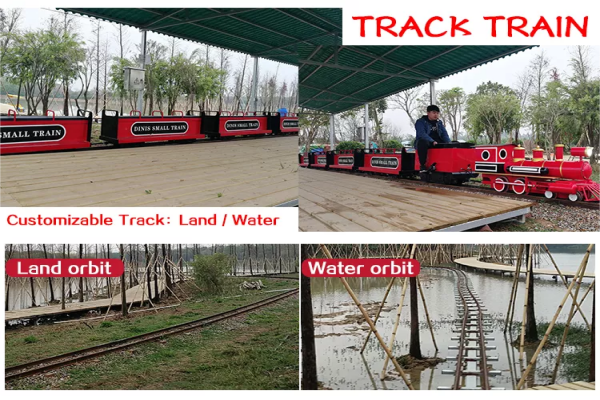
Thirdly, maintain the plane geometry of the line. The gravel can resist the longitudinal and lateral resistance of the rail. Maintain the correct geometric shape of the track. Maintain the smoothness and direction of the track. So to ensure that the track does not deform or displace.
Cushioning
Fourthly, cushioning and shock absorption. The gravek laid on the track make the track elastic enough to moderate the impact on the steel rail, thus it brings about a shock-absorbing effect.
Noise reduction
Fifthly, noise reduction, inhibition of plant growth. Laying stones on the rails can not only reduce the sound produced by the friction between the steel wheels and the rails when the train passes by, but also effectively inhibit the growth of plants on the rails. Accordingly, it remove the influence of obstruction from the plants when operate along the track. Consequently, save the human labor to remove the plants periodically.
In this passage,we exemplify the reason why to lay gravel for track trains. Hope you feel enlightened from our introduction. Dinis, a expert in amusement train rides design,production. We produce track train for outdoor use and trackless train for indoor use. Sincerely hope that we can reach win-win cooperation.
- Country
- Site size or plan
- Indoor or outdoor
- Rides you have in mind
- Opening date
Prefer to talk? WhatsApp us, or email [email protected]
How much gravel a track train route needs
The ballast layer is sized from the track, not from the site. Three numbers decide it.
- Track length. Track is quoted per metre, and the ballast follows the same length. Measure the loop before you ask for a price.
- Depth and width. The gravel bed spreads the load of the sleepers and drains water away from the rails; a thin layer fails in the first wet season.
- Sleeper spacing. Concrete sleepers sit on the ballast at a set spacing, and the gravel has to reach between them so the track cannot shift sideways.
Ask your contractor to quote the ballast with the track, not after it. On a 36-person track train or a 54-person model the route is the largest site cost, and the gravel is the part of it that protects the rest.